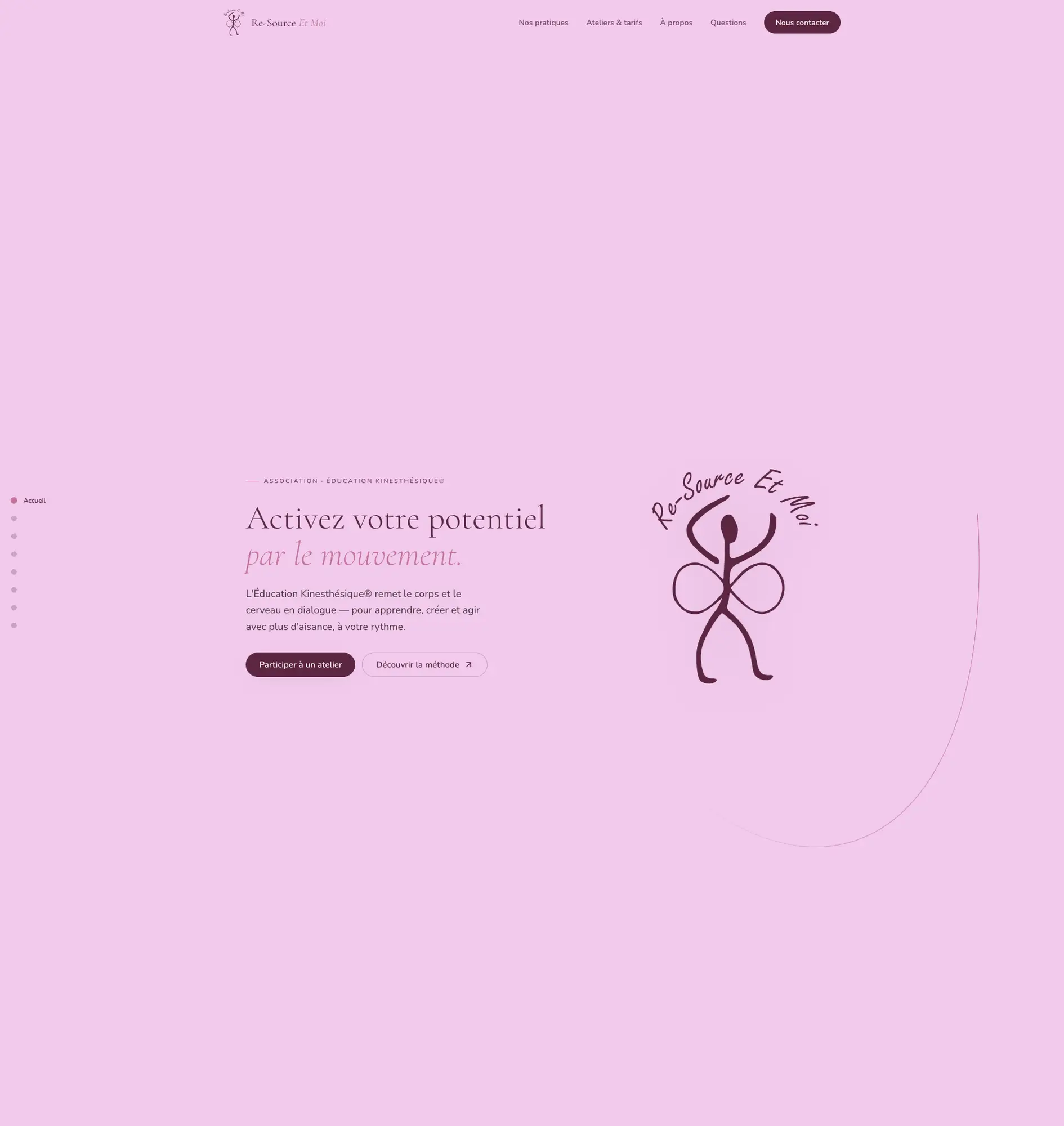
Re-Source Et Moi
Website for a Kinesthetic Education® non-profit: activities, workshops and pricing.
- Goal
- Present the association’s activities, keep an up-to-date list of workshops and events, show clear pricing and make getting in touch easy — on a stack that can be iterated on later.
- Result
- Turnkey client project, live since September 2026.
- Tech stack
- DjangoDRFNext.jsVercelNeonBrevo
The client, a non-profit association, needed a website to present its practice and its founder, publish its workshops and their pricing, show reviews and receive contact requests. Beyond the public pages, a dedicated admin interface, simpler than the Django admin, lets the association manage reviews, pricing and events on its own. Emails (contact form, password reset) are sent through Brevo. The Next.js front end relies on a Django / DRF API, hosted on Vercel with a Neon database. The site has been live since September 2026.
What I built
Most of the site’s copy is fixed, but three things change often: workshop dates, pricing and reviews. They come from the API, so the association can update them without a redeploy. A French-language editor manages workshops as a list or a monthly calendar, pricing groups with their lines, and reviews, which can be published or hidden in one click. The home page shows the three most recent published reviews. The association handles all of this on its own, without touching the code or waiting for me to make a change.
In the editor, every read and write requires a login, and login attempts are throttled. After each save, the public site’s cache is cleared, and the change shows up on the next request. For a forgotten password, a reset link, valid for two hours and usable once, is emailed through Brevo.
The stack and why
The Next.js front end fetches workshops and pricing on the server, so dates and prices are in the HTML that search engines read. If the API stops responding, the section shows an unavailability notice instead of an outdated price: a stale price is worse than no price.
The Django / Django REST Framework backend returns raw data (ISO dates, numeric amounts), and the front end handles French formatting. TypeScript types are generated from the OpenAPI schema and checked in CI, so the two sides can’t drift apart. On Vercel, a single project serves both under one domain: /api goes to Django and everything else to Next.js, with a PostgreSQL database on Neon.
Where it stands
The site has been live since September 2026, delivered as a turnkey project. It was built to target WCAG AA accessibility, on a foundation that leaves room to keep adding to it.